Key dates
March 3, 2025 Application period opens
April 9, 2025 2 p.m. ET Application period closes
Make sure you submit before the deadline!
July 2025 Applicants are notified of application outcome
Make sure your organization is eligible to apply
Review the kinds of projects and organizations we fund to ensure your project is eligible and aligns with our funding areas.
Prepare your submission
Review the sample application. Gather the documentation you’ll need to include in your application.
Have everything ready? Time to apply!
Log onto https://cira.smartsimple.ca/ and follow the steps below.
Project requirements
What are the keys to a successful project?
- Alignment with CIRA’s funding areas: infrastructure, online safety and policy engagement.
- Project benefits:
- Northern, rural and/or Indigenous communities.
- Students (from kindergarten to grade 12 and post-secondary).
- A well thought-out and realistic project plan, with clear steps and goals.
- Results should be open for everyone to use, share and build upon.
- A reasonable budget (even better if you show contributions from other sources or in-kind funding!).
- Demonstrates engagement of community stakeholders in development, delivery, financing, etc.
- Long-lasting impact, well after the grant period ends.
Preparing your application
Non-profit, charity or Indigenous community applicants:
- Proof of eligibility: documentation confirming your community or not-for-profit incorporation (e.g., articles of incorporation) and your charitable status, if applicable. Please note that tax forms are not valid.
- A board of directors/Band Council list with contact information, including the organizational affiliation and title, email address and phone number.
- A copy of your most recent audited financial statements. A tax return will not be accepted.
- An operating budget for January – December 2025.
- Three letters of support from community partners and/or community participants you expect to benefit from your project. Download example letters.
- A completed application form.
- A completed project budget. Download example budgets for each funding area.
University or college research applicants:
- Proof of eligibility: a letter confirming the lead researcher is employed by the academic institution.
- A board of directors list with contact information, including the organizational affiliation and title, email address and phone number.
- A copy of your most recent audited financial statements. A tax return will not be accepted.
- An operating budget for January – December 2025.
- A CV for the lead researcher on the project.
- Three letters of support from community partners and/or community participants you expect to benefit from your project. Download example letters.
- A completed application form.
- A completed project budget. Download example budgets for each funding area.
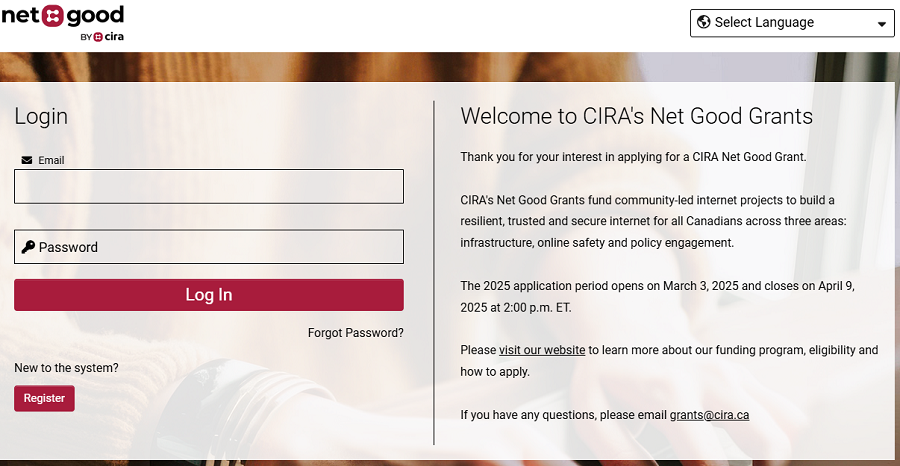
Access https://cira.smartsimple.ca/. You may choose your preferred language from the dropdown. All users must create an account to access the new system, even if you or your organization applied in previous years.
Click Register to sign up.
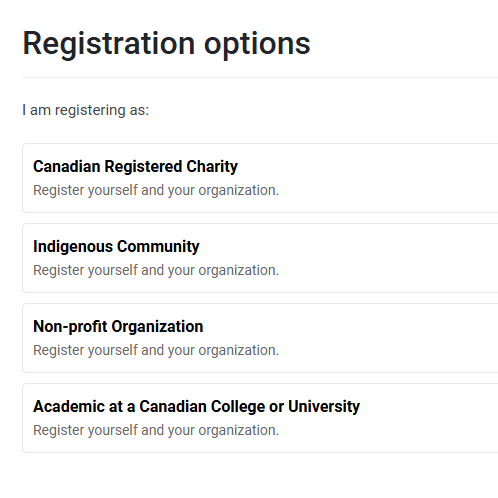
Choose the applicable type of organization and provide the required information including your organization and contact details.
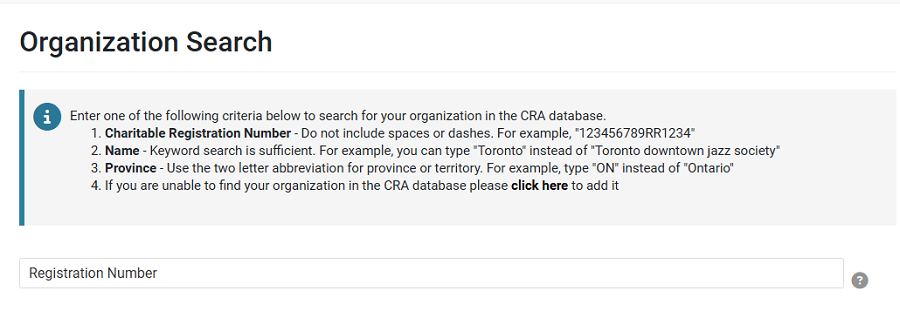
If you are applying as a registered charity, you can search for your organization’s information using your charitable registration number.
After completing registration, you will receive a welcome email inviting you to set your password. Once your password is set, you are ready to log in and apply for a grant!
Once you’ve registered, you can log in to your applicant portal. Here you can view and update your organization profile or click Apply Now to apply for a grant.
Applications that are drafts or require revisions are found under Action Items. Submitted applications are found under Completed Items.
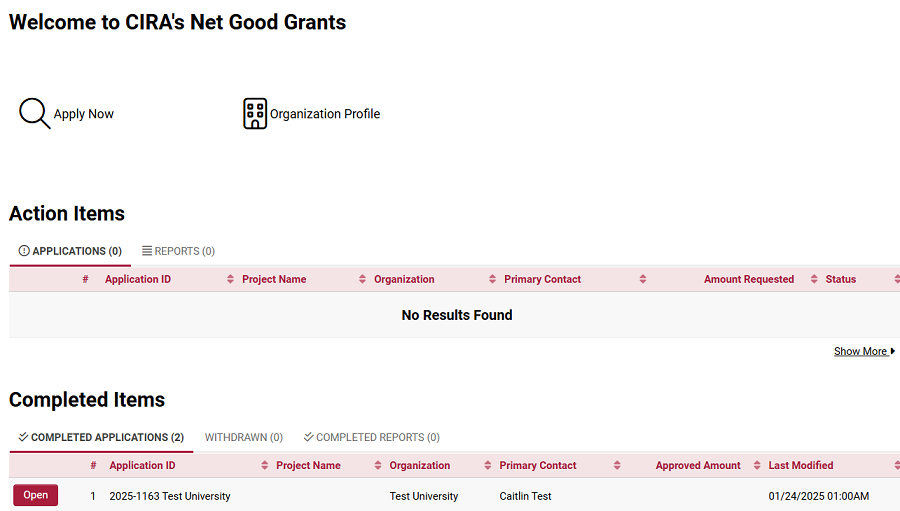
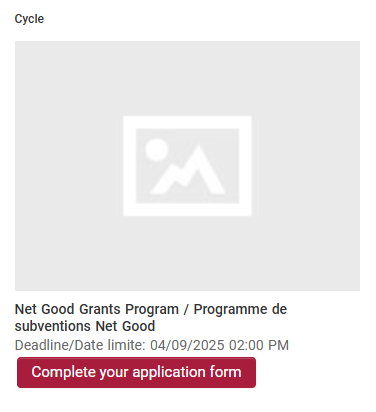
Click on Apply Now and on the next page click on Complete your application form to start filling out your application.
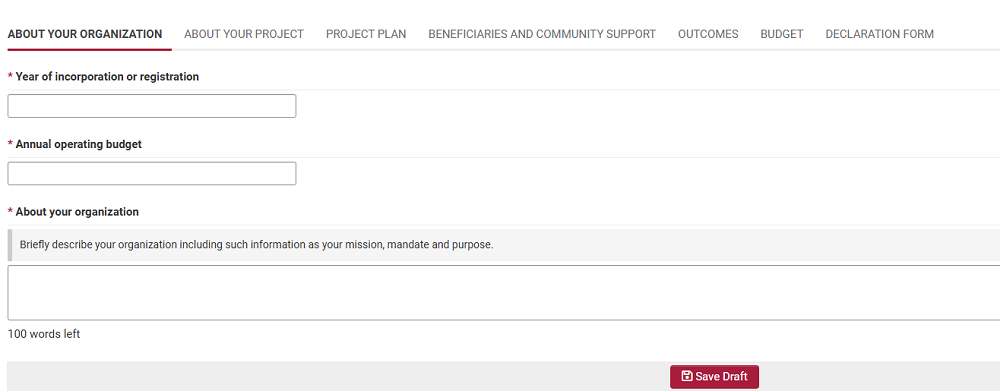
The application form consists of a series of sections organized into seven tabs. You may complete the sections in any order. Important tip: start by hitting Save Draft and save your work frequently! If you don’t save, you risk losing your progress.
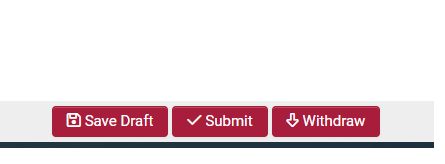
The most important step: when you’ve completed the application form, click on the big red Submit button at the bottom to ensure your application reaches CIRA before 2 p.m. ET on April 9.
Not checking your email
- You will receive important emails regarding your application from [email protected].
- Check your spam or junk folders if you don’t see our emails in your inbox.
Missing the deadline
- Submit your application as early as possible to ensure sufficient time for your application to be reviewed.
- Your application must be complete and all of your supporting documentation must be submitted by April 9 at 2 p.m. ET to advance to the next step.
Forgetting to press Submit
- It may seem obvious, but make sure you press Submit after completing your application! More than one applicant has missed this step in the past – and that means they missed out on being considered for a grant.
We cannot accept late applications. That’s why we recommend submitting applications well in advance of the deadline on April 9 at 2 p.m. ET. This also gives you the opportunity to fix any errors in your application – typically, half of the applications submitted require some adjustment before they can be accepted. Until 2 p.m. on April 9, you will have the chance to correct your application and send it back to us before the deadline. Tip: make sure you know what time 2 p.m. ET is in your time zone!
Eligible applications are evaluated by the CIRA Grants Evaluation Panel with the following rubric and given a score out of 100.
| Project Evaluation Criteria | % Score |
Project Plan
|
/25 |
Beneficiaries
|
/20 |
Community Support
|
/20 |
Outcomes
|
/15 |
Budget
|
/20 |
| Total | /100 |
We ask for three community letters of support with your application to demonstrate you are engaged with the community partners and/or participants that you expect to benefit from your project. What is the story behind why a grant is needed? What needs were articulated by the people your project will serve that encouraged you to develop a project? These letters show us you have developed relationships that will help the project succeed. Community members that could provide a letter might include:
- Teachers and/or parents that will benefit from tools and training for students regarding online safety.
- Residents or business associations in a community that will benefit from infrastructure upgrades to high-speed internet.
- Partner organizations that will be involved in project delivery.
Each letter should communicate the relationship with the applicant, their involvement with the project (current or future), and what direct or indirect benefits they expect to see.
Letters from people directly involved in the applicant organization (e.g., staff, board members) are not eligible.
Click here to find a list of past projects CIRA has funded along with stories and photos. We do ask on the application form that you distinguish how your project is unique from projects previously funded.
Yes, if the project is complete, you have submitted your final report, and there are no outstanding issues.
Unfortunately, due to limited funding and high demand, we are only able to fund about 15 per cent of the applications we receive.
Other reasons for an unsuccessful application might include:
- A lack of demonstrated support from community members and/or project partners.
- An unclear or unrealistic project plan.
- Not aligning with our funding areas and/or target beneficiaries.
Start by closely reviewing all of the material on our website. If you need further guidance, you can reach out to [email protected] and we’ll try to answer any questions. Keep in mind that CIRA staff simply assess the eligibility of an application and have no influence over which organizations receive grants.